Chad Richardson
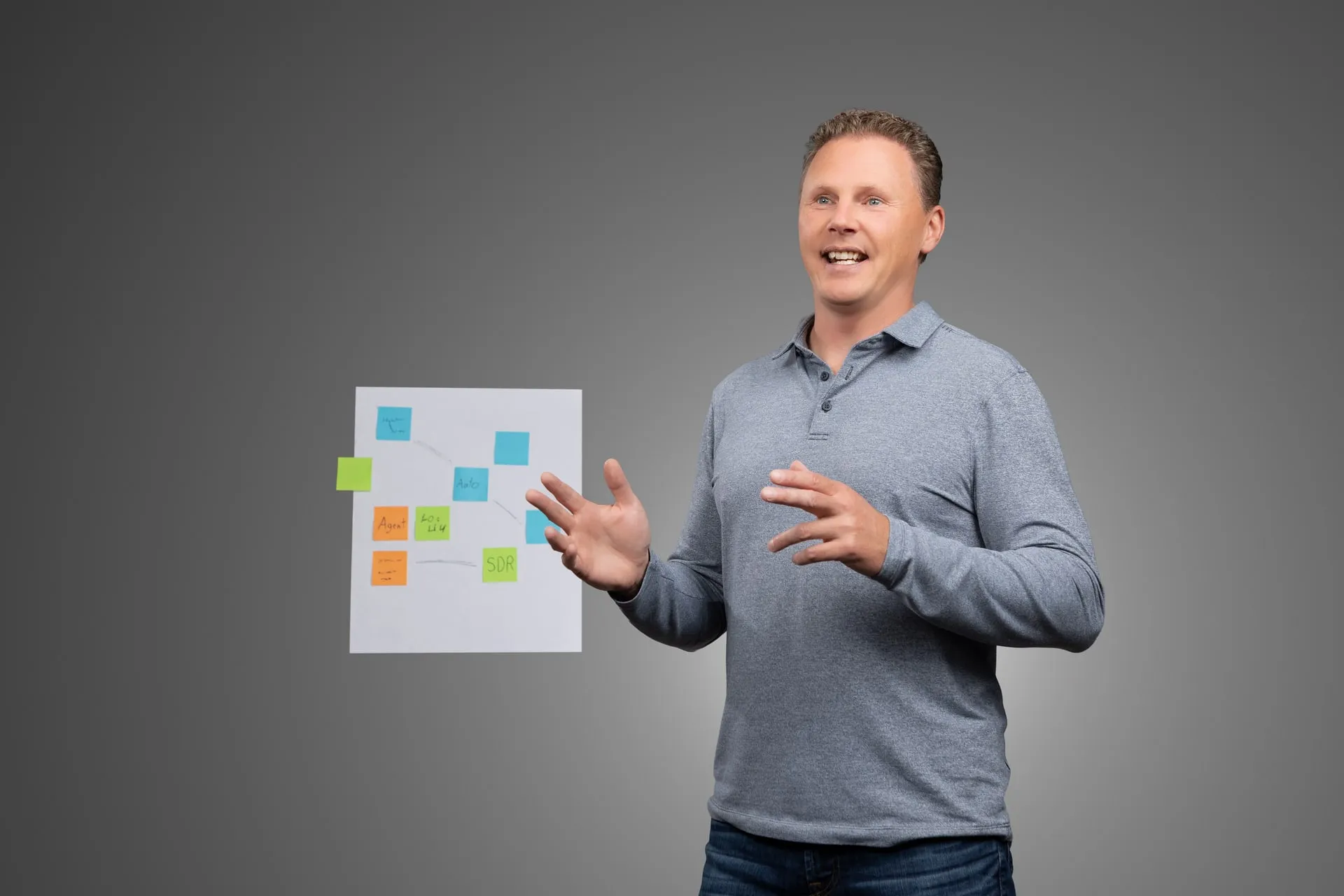
Chad Richardson talking through a flipchart covered in sticky notes and a hand-drawn flow.

Projects

Systems I've built, the friction they removed, and what they taught me.

Everything here runs in production, in a real business, today. No demos, no stalled pilots. Each one started with a friction point, and each one taught me something I carried into the next. That's the way I work, and it's the same way I build with clients.

01

Inbox Agent

Live, running multiple times a day

The friction

Remittance notifications, subscription invoices, receipts, and other recurring financial emails pile into an inbox daily. Every one needs to be saved and filed for accounting, a mundane chore that either eats time or falls behind.

What I built

An agent that watches the inbox for these emails, recognizes each type, and saves the email body or the attachment into a folder structure organized by fiscal calendar and account type (CAD, USD, VISA). Then it archives the email so the inbox stays clear.

What it delivers

A clean inbox, an organized filing system the accounting team can navigate without asking questions, and a recurring task that simply no longer exists.

What it taught me

This was my first successful build working with AI as a coding partner, and it proved the pattern: start with a small, well-defined friction point, automate it end to end, and let the win fund the confidence for the next one.

Recurring financial email arrives, an agent sorts it, and the result is a folder tree filed by fiscal calendar and account type.Agentreads, files,archivesFiscal yearCADUSDVISAA chore that no longer exists

02

Month-End Financial Analysis

Live, runs every month end

The friction

Closing the month meant 1 to 2 days of careful manual review: confirming everything was invoiced accurately, checking margins against plan, and hunting for anything that didn’t look right.

What I built

An automated month-end review that verifies invoicing accuracy, analyzes margins, and surfaces exceptions for a human to investigate, organized and ready before the coffee’s done.

What it delivers

A 1 to 2-day process now takes 30 minutes start to finish, and nothing slips through, because the system checks everything, every time, the same way.

What it taught me

The best automation targets aren’t always the exciting ones. A routine you’ve done forever stops feeling painful, and that’s exactly where the hours are hiding.

A month of invoices and margins goes through an automated review, and 1 to 2 days of checking comes out as 30 minutes with the exceptions flagged.Every invoiceReviewmargins,accuracy30 minwas 1 to 2 daysExceptionsNothing slips through

03

AI Clone

Live, my daily working partner

The friction

Working with AI out of the box means explaining yourself from scratch every session, and getting generic output that sounds like everyone else. The results are only as good as the context behind them, and I had none of mine written down.

What I built

During a 6-week AI Bootcamp, I built my AI clone on 3 foundational layers: a voice skill that captures how I actually write, a personal DNA that captures who I am and where I’m heading, and a business DNA that captures what my company is and how it operates. The introspective work of writing those layers turned out to be as valuable as the clone itself; it forced a clarity about my goals I didn’t have before.

What it delivers

An AI co-worker that understands where I’m heading. It pushes back when something I’m starting deviates from my stated path, makes recommendations that actually fit my goals, and surfaces blind spots I would have walked right past. Every project below this one got better because this one exists.

What it taught me

These 3 layers are foundational to working with AI, and well worth the effort before anything else gets built. AI amplifies what you feed it, so feed it what matters first.

Voice, personal DNA, and business DNA form 3 stacked foundation layers, with every later project resting on top of them.SDR AgentMonth-EndContentBusiness DNAPersonal DNAVoicethe foundationFeed it what matters first

04

SDR Agent

Live, fully autonomous

The friction

For years, my business partner ran our outbound prospecting: tedious work uncovering green-field opportunities, researching each one, and tailoring individual cold emails. When he retired, that work landed back on me. We tried outside SDR services, and while they generated leads, the cost per successful lead was tough to justify. I figured if I could build the SDR myself, I could get the results at a fraction of the cost, and make the math work.

What I built

An autonomous agent that runs the entire outbound pipeline: researching companies, identifying the right contacts, generating genuine insights about each organization, writing and sending 1-to-1 personalized emails, and reporting its status to me daily.

What it delivers

Outreach built on real research, at a fraction of the cost of the services it replaced, running every day without being asked, and holding a ~3% response rate, right at the industry average for service businesses.

What it taught me

Autonomy is earned in layers. An agent needs clear boundaries, quality gates, and honest reporting before you hand it the keys, exactly like onboarding a new team member.

A loop running every day: research a company, find an insight, send a 1-to-1 email, report back, and start again.ResearchInsightEmailReportevery dayOutreach built on real research

05

Content Workspace

Live, V2

The friction

Sharing what I’m learning matters to me, and creating content for a blog, LinkedIn, and X takes real time, especially keeping everything in my own voice instead of generic AI output. Carving out that time each week kept slipping behind more pressing items, and my content strategy stumbled with it.

What I built

A structured content workspace built on Interpretable Context Methodology (ICM): plain Markdown files, numbered folders, and a staged pipeline that turns 1 raw idea into a blog article, a LinkedIn post, and X posts, each tuned to its platform, all in my voice. It grew out of an earlier AI skill I had built for the same job, and the ICM rebuild improved it in 3 ways: a structured workflow that puts me in the loop at key checkpoints so the content lands the way I want, image generation built directly into the pipeline instead of handled separately, and a feedback layer that watches my edits so my voice skill keeps getting more dialed in over time.

What it delivers

1 idea in, 3 finished pieces out with supporting images, my voice intact, and my editing time cut dramatically.

What it taught me

AI amplifies what you feed it. Invest in the foundational context first (who you are, how you write, what you believe) and everything downstream gets better. Skip that step and you get faster, larger messes.

1 idea enters a numbered, staged pipeline and leaves as 3 finished pieces: a blog article, a LinkedIn post, and X posts.1 idea01draft02review03shapeBlogLinkedInXMy ideas, my voice, intact.

06

This Website

Live, you're reading it

The friction

I needed a home base for this chapter: a place to share what I’m building and learning, connect with business owners and fellow builders, and house it all somewhere I own. And I wanted it to feel like me, not a resume.

What I built

The site you’re on right now. Built on Astro, hosted on Cloudflare Pages, with content co-created working alongside my AI clone, from site framework through every page draft, exactly the way I work with clients: discovery first, then drafts, then iteration. The blog is fed directly by the ICM content pipeline above.

What it delivers

A working example of the process I offer. The site is both the story and the proof.

What it taught me

Being your own client is clarifying. Every step I ask a client to trust, I’ve walked myself.

Approved copy decks feed a build, and the build deploys to the live site.Copy decksBuildMarkdown in,pages outLive on pushThe story and the proof
Riley, a cel-shaded illustrated character with short dark hair and a teal collared shirt, wearing a name tag that reads RILEY AI.

The common thread

Riley AI

What started as a curiosity to build the utopian all-in-one AI agent has transformed into the persona of my learning journey.

My first attempt at a general-purpose agent was impressive on the surface and incredibly frustrating underneath. It would confidently assure me tasks were underway, and the actual logs told a different story. Riley, my AI operator sidekick, carries every hard lesson from that build and the ones since: memory that forgets, confidence without competence, the gap between claimed and completed. Those lessons shaped how I build every production system above, and Riley remains where I break things so client systems don’t.

You’ll find Riley AI throughout the content I share, the common thread to my building and learning in public.

The biggest lesson Riley keeps teaching: untrained AI is an untrained employee. You would never drop a new hire into a complex role with zero context and expect their best work. The training, the feedback loop, and the review are where the value gets created. That’s exactly how I’ve worked with AI in the localization space for years, and it holds true for every system I build.

Every one of these started the same way

A friction point, a conversation about what better would look like, and a build. If something in your business fits that description, I'd enjoy hearing about it.

Let's talk